- Home
- Products
- Plastic Film Pelletizing Machine
- Woven Bag Pelletizing Machine
- Rigid Material Pelletizer
- Plastic Bottle Granulator
- Plastic Pelletizing Machine
- Compactor Pelletizing Machine
- Fabric Fiber Recycling Granulator
- PET Flakes Plastic Pelletizer
- Parallel Twin Screw Pelletizer
- Plastic Film Washing Machine
- Agglomerator/Densifier/Compactor
- PVC Pelletizer
- PET Washing Machine
- Plastic Squeezing Pelletizing Machine
- Screen Changer
- Plastic Granule Cutter
- Plastic Accessory Machinery
- Solution
- Applications
- Video
- About Us
- News
- Contact Us
- 20 Years |
- 200+ Employees |
- 10K+ Customers |
- 20K+ ㎡ Area |
- CE


Compression Molding: From Raw Materials To Products
Time:2025-08-14
Compression molding, a pivotal forming process in industrial production, plays an irreplaceable role in the processing of materials such as plastics, rubbers, and ceramics, thanks to its unique principles and operational procedures. Its core logic lies in enabling solid raw materials to undergo a transformation from a loose state to a densely formed one within the mold cavity through the dual action of heating and pressurization, ultimately yielding products that meet the designed requirements.
Before the initiation of the compression molding process, meticulous preparatory work is fundamental to ensuring the smooth progression of subsequent procedures. The selection of raw materials must strictly align with the performance requirements of the products. Whether it is thermosetting plastic powder or granular raw materials, they need to be screened to remove impurities. If necessary, drying treatment is also required to avoid defects such as bubbles in the formed products due to the presence of moisture. The preparation of the mold is equally crucial. The cavity composed of the female mold (lower mold) and the male mold (upper mold) must be thoroughly cleaned to ensure uniform mold clamping clearance. In some cases, a release agent needs to be applied to the surface of the cavity to facilitate the smooth removal of the product later. For thermosetting plastics or high-melting-point materials, the preheating of the mold is of vital importance. Heating it to a specified temperature can effectively reduce the temperature difference between the raw materials and the mold, thereby enhancing the fluidity of the raw materials.
 |
 |
 |
| With the Feeding belt conveyor, the pre – treated raw materials are transported to the next link in an orderly manner. This equipment is like an industrial “conveyor belt”, ensuring that the raw materials enter the system continuously and stably, laying the foundation for mass production. | |
| The raw materials enter the First level extruder and second level extruder. Through the rotation and heating of the screw, the solid raw materials are gradually melted and plasticized to form a molten mass with fluidity. The design of two – stage extrusion is like “double grinding”, making the plasticization of the raw materials more uniform and providing a “suitable fluid” for filling the mold cavity. | |
| The molten mass after plasticization is accurately measured by the Plastic quantitative container. It is like an industrial “graduated cylinder”, strictly controlling the amount of raw materials entering the mold — too much will lead to excessive flash, and too little will result in insufficient filling, which is a key link to ensure product accuracy.The molten mass after plasticization is accurately measured by the Plastic quantitative container. It is like an industrial “graduated cylinder”, strictly controlling the amount of raw materials entering the mold — too much will lead to excessive flash, and too little will result in insufficient filling, which is a key link to ensure product accuracy. | |
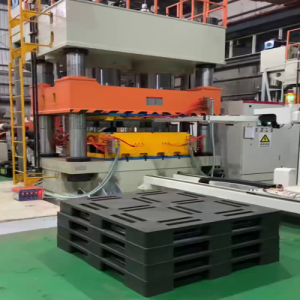
| The quantitative molten mass enters the mold, and the Tray hydraulic press is started. The hydraulic press provides a stable pressure (10 – 50MPa), pushing the punch and die to close, allowing the molten mass to fill and solidify in the mold cavity (thermosetting plastics need to be heated for cross – linking, and thermoplastic plastics are cooled and shaped). The vent holes of the mold discharge air and volatile substances simultaneously to ensure the compactness of the product. | |
| After molding, the Material retrieval robotic arm accurately grabs the product, replacing manual product removal, which is efficient and stable. Subsequently, the Finished product palletizing equipment stacks the products in an orderly manner, completing the transition from “individual products” to “mass storage”, adapting to the rhythm of industrial logistics. |
 |
After the product is demolded, it needs to undergo flash trimming, secondary processing (drilling, polishing, etc.), and quality inspection in terms of dimensions and performance to screen out qualified products. Moreover, mold cleaning and raw material recycling (supported by some processes) make the entire compression molding process form a “closed – loop”, taking into account both efficiency and cost.
With advantages such as simple equipment, low mold cost, and suitability for complex products (large – sized, thick – walled parts), this process is widely used in fields such as electrical parts and auto parts. From feeding, plasticizing to molding and palletizing, automation and precise control run through the whole process, which not only ensures product quality but also meets the needs of industrial mass production — this is the “irreplaceable” logic of compression molding in modern manufacturing.
In short, the complete process of compression molding is a “cooperative battle” of raw materials, equipment, and automation. From the starting point of belt conveying to the end point of robotic arm palletizing, each step explains that the core of industrial manufacturing is to turn “raw materials” into “products” through precise control, like an art.
Leave a Reply